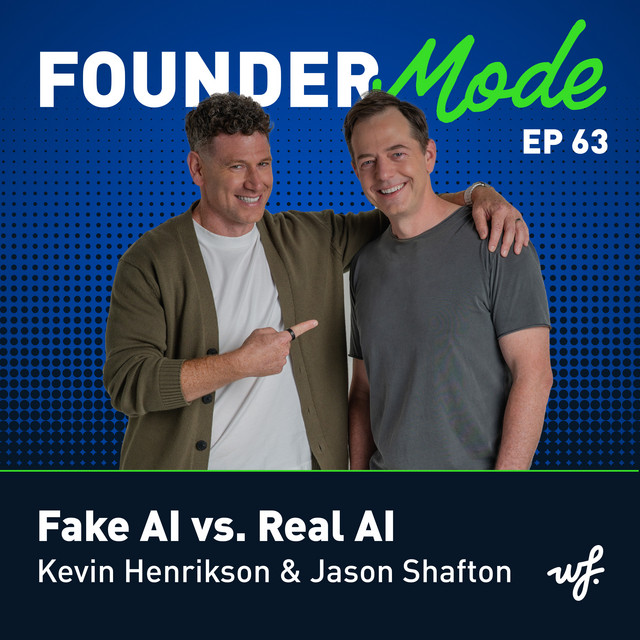
Fake AI vs Real AI
Welcome back to Founder Mode!
In this episode, Jason and I sat down without a guest to talk about what we've been seeing firsthand in AI.
After attending an industry conference, one thing became obvious.
A lot of companies say they're doing AI.
Very few can explain how.
When I started asking one simple question, "What's your stack?", the answers told me everything I needed to know.
Some executives couldn't answer.
Others admitted their "AI" was actually teams of people manually moving files between systems.
That conversation led us into a much bigger discussion about where the real opportunity in AI actually lives.
Let's get into it.
1. Don't Build the Brain. Build the Nervous System.
Everyone wants to build the next foundation model.
Very few people need to.
The biggest opportunity isn't creating another large language model.
It's connecting today's models to real businesses.
As I said during the episode:
"The actual foundation models are smart enough."
Most businesses don't need a smarter model.
They need someone who understands their workflow and knows how to plug AI into it.
Healthcare.
Manufacturing.
Professional services.
Marketing.
Every industry has repetitive work waiting to be connected.
The companies that win won't build the smartest AI.
They'll make AI useful.
2. Ask One Question: "What's Your Stack?"
One of the funniest moments from the conference happened after a speaker finished talking about AI.
I asked a simple question.
"What's your stack?"
Most people couldn't answer.
One person admitted their AI workflow depended on outsourced teams manually downloading audio files and passing them between people.
It wasn't AI.
It was humans wearing an AI costume.
That's a useful reminder.
If leaders can't explain what powers their product, they probably aren't using AI as deeply as they claim.
Understanding your stack matters.
Not because the model itself is your competitive advantage.
Because it tells you whether you're actually building something real.
3. AI Makes Good Work Better
One mistake I see is founders trying to replace entire workflows overnight.
A better approach is much simpler.
Take something you're already doing well.
Ask AI to improve it.
Then work backward.
Can AI gather the data?
Can it clean it?
Can it make the report better?
Can it generate the first draft?
Eventually those improvements connect into one workflow.
That's how AI adoption actually happens.
Not through one giant leap.
Through dozens of small improvements.
As I said during the episode:
"It can make the thing I'm doing better. That's awesome."
That's where momentum starts.
4. Taste Still Matters
AI is getting smarter every month.
But it still needs direction.
Jason made a great point about marketing.
AI can generate campaigns.
It can build proposals.
It can summarize meetings.
But someone still needs to decide what's good.
I described it this way:
"Taste and error correction... those are the moat."
That's becoming more important, not less.
Everyone has access to the same models.
Very few people know how to improve the output.
That's still human work.
5. Human Experiences Become More Valuable
As AI drives the cost of digital work lower, something interesting happens.
Human experiences become more valuable.
People will still pay for concerts.
Live events.
Personal service.
Real conversations.
Those things don't disappear.
They become premium.
I don't think AI replaces human connection.
I think it increases the value of it.
The companies that understand where automation ends and relationships begin will have an advantage.
Final Thoughts
This conversation reminded me that AI isn't creating entirely new businesses.
It's exposing old ones.
The winners won't necessarily have the biggest models.
They'll have the best systems.
They'll understand their customers.
They'll connect AI to real work.
And they'll keep humans focused on the parts that matter most.
The opportunity isn't to build another brain.
It's to wire intelligence into places where it creates real value.
5 Key Takeaways
- Ask every AI company one question: "What's your stack?"
- The biggest opportunity is connecting AI to real business workflows.
- Start by improving existing work before trying to automate everything.
- Taste and error correction are becoming valuable competitive advantages.
- As AI lowers software costs, authentic human experiences become even more valuable.
🎧 Listen to Episode 63 here:

This podcast builds on the Founder Mode newsletter.
Let’s build.
-kevin
2810 N Church St #87205, Wilmington, DE 19802
Unsubscribe · Preferences