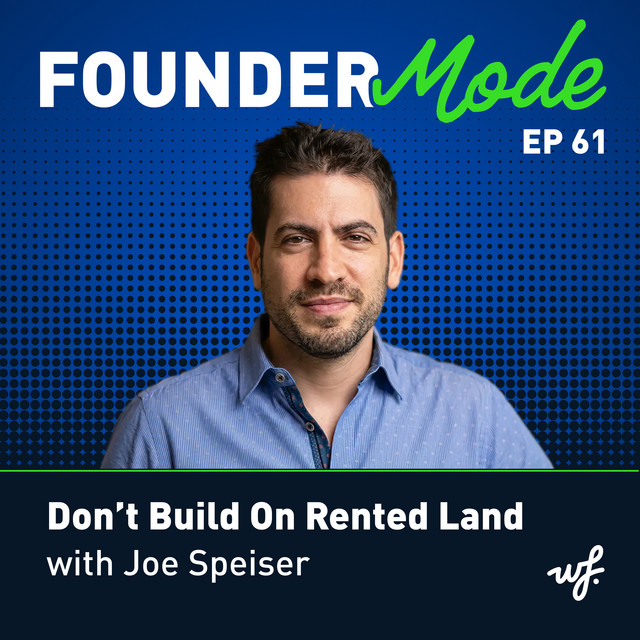
Don't Build On Rented Land with Joe Speiser
Practices spend money generating leads, but lose patients because no one answers the phone, follows up fast enough, or handles intake after hours.
We're doing a 45-minute session on how top healthcare practices are using voice AI to capture and convert more patients 24/7.
Live Webinar: June 25, 2026, at 12:00 PM PDT
You'll see:
- Where healthcare practices lose revenue after the lead is generated
- A live AI-powered patient intake and scheduling demo
- How specialty practices are using voice AI today
- A framework you can bring back to your own practice or clients
If you're in healthcare, it's worth attending.
Hope to see you there.
|
Welcome back to Founder Mode!
This episode was a reminder that some of the biggest opportunities are hiding in plain sight.
Jason and I sat down with Joe Speiser, co-founder of Hampton and a founder who has spent decades building companies, winning, losing, and learning.
What stood out to me was not a growth hack or AI tactic.
It was the way Joe thinks about opportunity.
He described every business as an arbitrage opportunity. A gap between what exists and what should exist.
That idea showed up throughout the conversation.
From building on rented land, to finding overlooked markets, to creating communities that people actually want to be part of.
Here are the lessons that stuck with me.
1. Every Great Business Starts With an Arbitrage
Joe's answer to what made him successful was surprisingly simple.
He said:
"I always like the arbitrage of it. Trying to figure out what that arbitrage is and just exploiting it."
That mindset explains a lot.
Most people see a business category.
Founders see a gap.
Sometimes it is a pricing gap.
Sometimes it is a distribution gap.
Sometimes it is a customer experience gap.
The founders who consistently win are the ones who can spot those gaps before everyone else notices them.
The hard part is not finding the opportunity.
The hard part is acting before everyone else does.
2. Never Build on Rented Land
Joe shared one of the most painful lessons of his career.
His company built a massive scale using Facebook traffic.
Then Facebook changed.
The traffic disappeared.
The company lost what could have been a nine-figure outcome.
As Joe said:
"We built on rented land."
That phrase should make every founder stop and think.
Today, it might be Facebook.
Tomorrow it might be Google.
It could be Reddit, YouTube, TikTok, or even AI search.
The lesson is not to avoid platforms.
The lesson is to build something people remember when the platform changes.
The strongest companies own their audience.
They own their customer relationships.
And they build a brand people seek out directly.
3. Community Is Harder Than Software
One thing I found fascinating was hearing Joe describe Hampton.
At its core, Hampton is not a software company.
It is a people company.
As Joe put it:
"We're just organizing people."
That sounds simple.
It is not.
Software is predictable.
People are not.
One bad hire can hurt a team.
One bad member can hurt a community.
Joe talked about reviewing every member application personally because protecting the quality of the group matters more than growing quickly.
That discipline is one reason Hampton works.
The best communities are curated, not collected.
4. AI Works Best When It Meets People Where They Already Work
Joe has gone deep into AI tools.
Like many founders, he experimented with building his own AI workflows.
Eventually, he realized something important.
The technology itself was not the bottleneck.
Adoption was.
People do not want another tool.
They want help with the tools they already use.
That is why AI inside Slack became so powerful for his team.
Instead of asking someone to learn a new workflow, the AI shows up where work is already happening.
That is a useful lesson for founders building AI products today.
The best product is often the one that removes a step.
5. The Best Founders Keep Learning
One thing I always appreciate about conversations like this is seeing how experienced founders still approach learning.
Joe did not become interested in AI because he needed it.
He became interested because he was curious.
He spent nights and weekends experimenting, testing, and learning.
Eventually, that curiosity became practical.
That pattern shows up everywhere.
The founders who stay relevant keep learning.
The tools change.
The platforms change.
The opportunities change.
Curiosity is what keeps founders moving forward.
5 Key Takeaways
- Every business has an arbitrage if you know where to look.
- Building on rented land creates long-term risk.
- Strong communities require active curation.
- AI adoption improves when it fits existing workflows.
- Curiosity remains one of the most valuable founder traits.
Final Thoughts
What I liked most about this conversation was how practical it felt.
There was no magic formula.
No secret growth hack.
No overnight success story.
Just a founder who kept looking for opportunities, learning from mistakes, and adapting when the market changed.
One quote from the episode captured it perfectly:
"The best arbitrage is the one nobody else is looking at."
That idea applies to products.
It applies to distribution.
It applies to careers.
And it applies to life.
The founders who consistently win are often looking somewhere everyone else has ignored.
🎧 Listen to Episode 61 here:

This podcast builds on the Founder Mode newsletter.
Let’s build.
-kevin
2810 N Church St #87205, Wilmington, DE 19802
Unsubscribe · Preferences