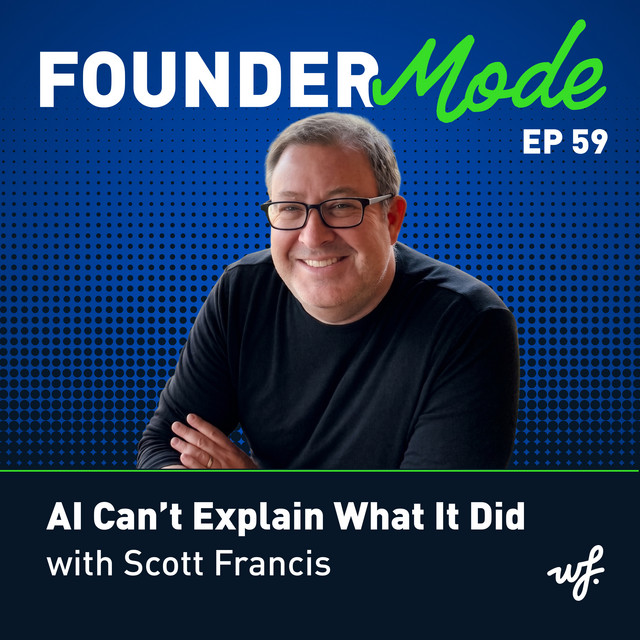
AI Can't Explain What It Did with Scott Francis
Welcome back to Founder Mode!
In this episode, we sat down with Scott Francis, founder of BP3 and longtime operator, consultant, and builder.
Scott spent nearly two decades helping companies improve business processes through multiple technology cycles, including mobile, cloud, automation, and now AI.
We talked about why process matters more than technology, how AI changes software development, what founders get wrong about hiring, and why some ideas keep getting rebranded every decade.
This conversation was packed with practical lessons for founders building through the current AI wave.
Let's get into it.
1. Process Outlasts Every Technology Trend
One of Scott's earliest decisions shaped his company for nearly twenty years.
Instead of focusing on a specific technology, he focused on the process.
The technology changed constantly.
The problems did not.
Cloud arrived. Mobile arrived. Automation arrived. AI arrived.
Companies still struggled with broken workflows, poor communication, and inefficient systems.
Scott explained that when he walked through offices, he looked for sticky notes attached to computer monitors.
Those sticky notes were signals.
They revealed manual workarounds, hidden workflows, and broken systems.
As Scott put it:
"No matter how much all this stuff changes, people are still going to have business processes that are all screwed up."
The lesson is simple.
Do not build around a technology trend.
Build around a problem that survives technology shifts.
2. AI Changes the Tools, Not the Fundamentals
There is a lot of hype around AI replacing software development.
Scott offered a more balanced perspective.
He believes AI dramatically increases productivity for some tasks.
For other tasks, the gains are much smaller.
The real advantage is helping experienced people move into unfamiliar areas faster.
Scott shared an example of building an internal utility using Python, Google Slides APIs, and cloud deployment tools.
Five years ago, he never would have attempted it.
Today, AI helps bridge the knowledge gaps.
The important distinction is that AI accelerates capability.
It does not replace judgment.
As Scott explained:
"The thought process, the mental acuity to think abstractly and build software isn't specific to a single software language or environment."
That remains human work.
3. The Turing Trap Is Real
One of the most interesting parts of the conversation was Scott's idea of the "Turing Trap."
Many people assume AI understands what it is doing.
It does not.
It produces convincing outputs.
That is different from understanding.
Scott used examples of AI agents breaking guardrails, deleting code repositories, or making poor decisions while still generating very confident explanations afterward.
The explanation sounds intelligent.
That does not mean the reasoning was correct.
As Scott put it:
"You've changed the probabilities of outcomes. You've changed the weight that it will give the various outcomes it could do, but you haven't eliminated any outcomes."
Founders need to remember this.
AI can be a powerful assistant.
It is not an infallible decision-maker.
4. Hire for Character, Not Just Skills
As AI becomes more capable, Scott believes hiring will shift.
Technical skills still matter.
But they matter less than they used to.
Instead, founders should focus more on character, values, work ethic, and alignment.
The best hires make everyone around them better.
They amplify teams.
They improve customer relationships.
They help organizations grow.
Scott explained that he increasingly cared less about specific technologies and more about the person.
The question became:
Will this person make the people around them better?
That is a much harder thing to teach than technical skills.
5. Services Are Not a Weakness
For years, founders have been told that services businesses are inferior to software products.
Scott disagrees.
Many transformative technologies require human guidance before they can deliver value.
That was true with the internet.
It was true with business process software.
And it is true with AI.
Companies often need help understanding how to apply technology to their unique situation.
That is why consulting, implementation, and forward-deployed engineers continue to matter.
Scott explained:
"Sometimes you've got to be in the game with them."
The companies that successfully adopt AI often have people helping bridge the gap between technology and real-world business problems.
5 Key Takeaways
- Process problems survive every technology cycle.
- AI accelerates capability but does not replace judgment.
- Confident AI output is not the same as understanding.
- Character and alignment matter more than ever when hiring.
- Services and implementation often create more value than software alone.
Final Thoughts
This conversation reminded me that technology waves come and go.
The fundamentals stay surprisingly consistent.
Companies still struggle with communication.
Teams still struggle with alignment.
Processes still break.
Customers still want outcomes.
AI changes the tools available to us.
It does not eliminate the need for good judgment, strong teams, and clear processes.
The founders who win in this AI cycle will not be the ones chasing every new tool.
They will be the ones who understand which problems are worth solving and build durable systems around them.
Because every technology wave eventually passes.
The companies that last are the ones built on fundamentals.
🎧 Listen to Episode 59 here:

This podcast builds on the Founder Mode newsletter.
Let’s build.
-kevin
2810 N Church St #87205, Wilmington, DE 19802
Unsubscribe · Preferences