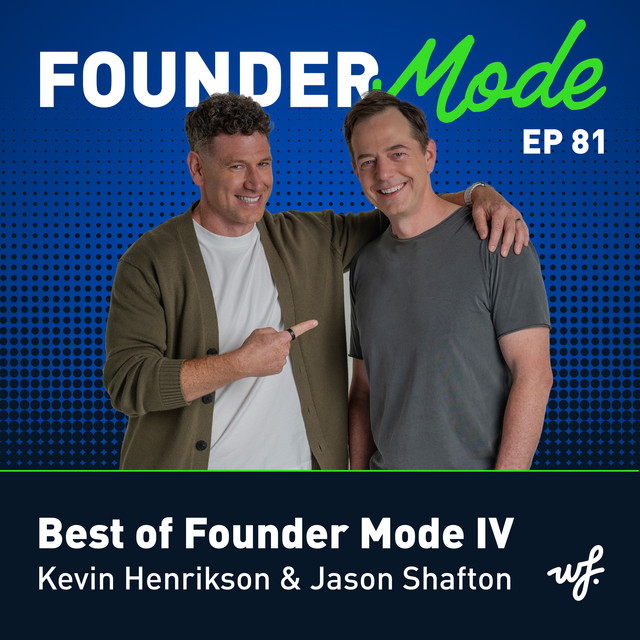
Founder Mode Episode 81 - Best Of Founder Mode IV (Plus: Athena Owns the Ledger with Max Alsgaard-Miller)
I have two shows for you this week.
First, check out the newest episode of Founder Mode. Then stick around for episode eight of the Pretty Good AI Podcast.
Welcome back to Founder Mode!
🎧 Listen to Founder Mode Episode 81 here:

This is our fourth "best of" roundup, covering episodes 61 through 80. This batch of episodes was heavy on AI: agents running the back office, agents in the inbox, a couple of experiments that didn't work at all. But going back through the tape, the moments that actually stuck were mostly about people.
A few of the ones we kept coming back to: Anthony from Daily Body Coach, who fired twenty people, moved countries, and worked nine months straight until his body forced the issue with mystery headaches that turned out to be pure stress (Episode 67). Jess Chan from Longplay, on the hardest calls she's made in seven years, which were all about choosing to grow slower instead of chasing the hockey-stick curve (Episode 71). Seek Sahib, on the night he decided to shut his company down and why he showed up at the office again the next morning anyway (Episode 62). And Keith Wasserman from Gelt, who's done billions in real estate deals and, when the market turned, started personally calling every one of his 1,800 investors (Episode 80).
The AI moments held up too, mostly because they were honest about what went wrong. I counted 76 scheduled agents running across my tools, personal and business, only to find one of them had been reporting "success" for eight days while silently writing its output to a folder that no longer existed (Episode 72). I've started handing whole email threads to Claude with one instruction, "do the right thing," and watched it catch a billing error and push back on an invoice before I'd even read either one myself (Episode 69). And Mo made the point that still holds up the best: agents can do the work, but the accountability for approving it never leaves a human's hands, and sending something you haven't personally read is just plain rude, whether an AI wrote it or not (Episode 73).
Instead of five takeaways this time, here's the thread that ran through all twenty episodes: the biggest change in this stretch was how much work we're handing to AI, 76 agents, Claude checking our own invoices. What didn't change was everything around it. Who's accountable when something breaks. How you treat your customers and your investors. Whether you're actually taking care of yourself. The founders who impressed us most this batch all knew exactly what they weren't willing to hand off.
"Hand off the work, keep the judgment."
- Kevin Henrikson
🎧 Listen to Pretty Good AI Episode 8 here:

My guest this episode is Max Alsgaard-Miller, who spent over a decade inside Athena Health across implementation, product, and marketplace marketing before leaving to advise companies building on the Athena marketplace full-time. His Q3 marketplace report just came out, and it's the most data I've seen anyone bring to this conversation: 870 new practice connections in the quarter, over 26,000 total practice-to-partner connections, and 30 partners joining against only 11 leaving.
Max walked through how the marketplace actually started: Athena's old CEO Jonathan Bush was obsessed with Clayton Christensen's disruptive-innovation theory, so Athena deliberately invited the companies that could have disrupted it onto its own platform instead, a program literally called "More Disruption Please." Two decades later, that bet is still paying off, and AI has poured gasoline on it. Half of all current marketplace partners joined after ChatGPT launched. AI phone agents alone went from 28 new connections in Q2 to 115 in Q3, and Pretty Good AI came in as the second-fastest-growing partner on the entire marketplace, and the fastest-growing AI company on it.
We got into why going deep on one platform beats going wide across many. Athena publishes documentation for 838 APIs (we've built against 828 or 829 of them), which means real integrations are possible, versus EHRs still running on an old server in a clinic basement where every connection has to be rebuilt client by client. Companies that market "we support all EHRs" are usually thin by necessity, often leaning on Chrome extensions or screen-scraping RPA that breaks the moment a UI changes, because there's no review process checking the work before it ships. Max's framing for the whole ecosystem: Athena still owns the ledger, the patients, the providers, the core record, but the edge- texting, scribes, revenue cycle, phone calls- is where all the real innovation and competition is happening now, faster than Athena's own internal teams can match.
Here's how Max's data led Kevin to sum up the episode:
"Athena owns the ledger, startups own the edge."
-Kevin Henrikson
Final Thoughts
Both episodes this week land on the same basic question: what should actually stay in human (or in Athena's) hands, and what should get handed off. Founder Mode's twenty-episode retrospective kept circling back to accountability, judgment, and taking care of the people around you, even as more of the raw work moves to agents. Max's data says something almost identical about healthcare software: the core ledger stays put, but everything happening at the edge, where the actual innovation lives, is up for grabs. Own the thing that matters, and let the edge get as competitive as it wants to be.
Watch the new Founder Mode episode, then listen to episode eight of the Pretty Good AI Podcast. Subscribe so you don't miss what's next.
This podcast builds on the Founder Mode newsletter.
Let’s build.
-kevin
2810 N Church St #87205, Wilmington, DE 19802
Unsubscribe · Preferences