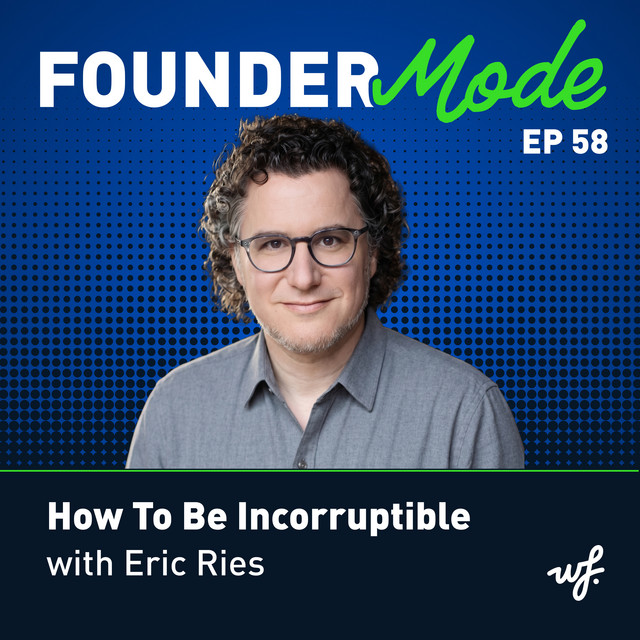
How To Be Incorruptible with Eric Ries
Welcome back to Founder Mode!
In this episode, we sat down with Eric Ries, author of The Lean Startup and his new book, The Startup Way. But this conversation was different.
It was not about finding product market fit.
It was about what happens after.
We talked about mission drift, governance, trust, and why some companies slowly lose the thing that made them special in the first place.
One line from Eric stuck with me immediately:
“The more successful an organization, the more valuable it is as a target.”
That sounds obvious once you hear it. But most founders are taught the opposite. We are taught that success creates freedom. Eric argues that success actually creates pressure.
And honestly, I think he is right.
Let’s get into it.
1. Success Does Not Protect You
Most founders think the hard part is getting traction.
Eric’s point was that traction is often where the real danger starts.
As companies grow, they attract more investors, more pressure, more politics, and more people trying to influence the direction of the business.
I said this during the episode:
“Are we making durable decisions?”
That question matters more than ever once a company starts working.
A lot of companies drift slowly. It is not usually one giant mistake. It is a thousand small compromises.
Eric shared a stat that stayed with me:
“According to Harvard Law School, 80% of founders will no longer be CEO three years after an IPO.”
That is not a rare outcome. That is the expected outcome.
2. Costco Is Not an Accident
One of the best parts of the conversation was the story of Sol Price.
I grew up going to Price Club before it became Costco. I had no idea that the founder of Price Club had first built another company called FedMart, then lost control of it.
Eric explained how FedMart slowly drifted away from its original mission after investors pushed for more profit, more expansion, and more optimization.
Eventually, Sol Price got pushed out.
Then he started over.
That second company became Price Club, which later became Costco.
What made Costco different was not just the business model.
It was the structure.
Eric described it as “ethos plus integrity.”
The company’s mission was protected structurally, not just culturally.
That distinction matters.
3. Culture Alone Is Not Enough
This part hit hard for me.
A lot of founders talk about culture. But Eric pushed deeper than that.
He argued that companies become vulnerable when their legal and financial structure does not match their stated values.
I asked him directly:
“What are the forces that are actually pulling these companies off track?”
His answer was that most organizations are built around shareholder primacy by default, whether founders realize it or not.
That means the pressure to optimize for short-term financial outcomes eventually wins unless the company is intentionally designed another way.
That is uncomfortable to think about, especially in startups.
But I think it is true.
4. You Do Not Own the Company Forever
Eric used a phrase that I cannot stop thinking about.
He said:
“You do not own your company. You birthed it.”
That is a very different mental model.
Founders often believe they can control the company forever through force of will. But companies eventually become living systems with their own incentives, politics, and behaviors.
That is why governance matters.
That is why structure matters.
That is why the first decisions matter more than founders realize.
And in a world where AI accelerates growth and scale even faster, I think this problem becomes bigger, not smaller.
5. Start With Intention Early
One thing Eric repeated several times was this:
It is never too early.
Founders tend to delay these conversations because they think they are “later stage” problems.
But by the time the company is large, changing the structure becomes much harder.
I thought this line from Eric summed it up perfectly:
“It’s too early until it’s too late.”
That is the tension.
If you care about how the company behaves long term, you have to design for that early.
Not after product market fit.
Not after the Series B.
Not after the IPO.
Early.
5 Key Takeaways
- Success creates pressure, not protection.
- A strong culture is not enough without an aligned structure.
- Costco became durable because it protected its mission structurally.
- Founders cannot rely on control forever.
- The earlier you define your intentions, the easier they are to protect.
Final Thoughts
This episode made me think differently about what building a company actually means.
Most startup conversations focus on growth.
Revenue.
Fundraising.
Velocity.
Eric pushed the conversation somewhere deeper.
What happens when the company succeeds?
Does it still behave the way you intended?
Does it still create value the right way?
Does it still deserve trust?
I have always thought about capitalism as a scoreboard. But this conversation reminded me that how you win matters too.
And in a world where companies scale faster than ever because of AI, governance and alignment probably matter more than they ever have before.
Because the moment your company starts working is the moment you have to start protecting it.
🎧 Listen to Episode 58 here:

This podcast builds on the Founder Mode newsletter.
Let’s build.
-kevin
2810 N Church St #87205, Wilmington, DE 19802
Unsubscribe · Preferences