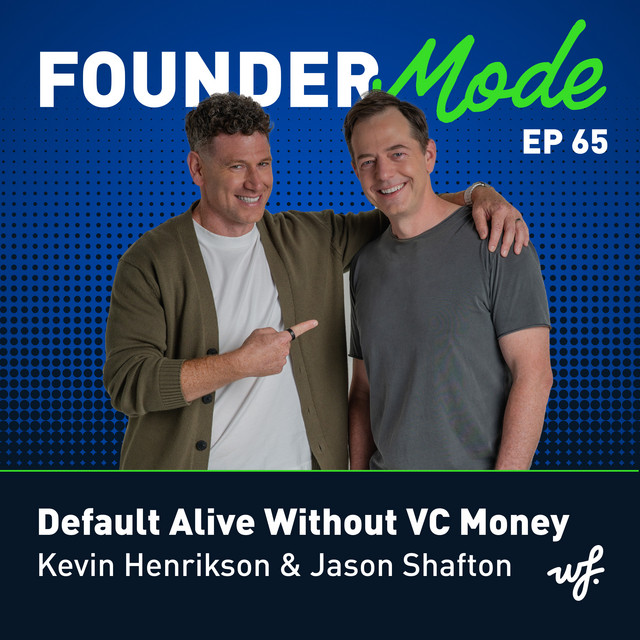
Default Alive Without VC Money
Welcome back to Founder Mode!
AI is moving so fast that it's easy to focus on the wrong thing.
Every week there's a new model. A new benchmark. A new company claiming to have the smartest AI.
But after this conversation, I don't think that's where the real opportunity is.
The founders who are winning aren't building a better brain.
They're building a better nervous system.
They're connecting AI to real businesses, real workflows, and real customer problems.
That's where the value is.
Let's get into it.
1. The Best AI Isn't the Business
At a recent industry conference, I kept asking one simple question: "What's your stack?"
Most people couldn't answer it.
Some told me to ask their CTO.
Others admitted they were using wrappers without really understanding what was underneath.
One company claimed they had an AI-powered workflow.
When I dug deeper, their "AI" turned out to be people manually downloading audio files, sending them to another outsourced team, and having humans generate the insights.
That one question exposed who was actually building with AI and who was just selling the idea of AI.
Technology alone isn't the advantage anymore.
Knowing how it all fits together is.
2. Build the Nervous System, Not the Brain
Everyone wants to build the next foundation model.
I think that's the wrong game.
The biggest opportunity is taking today's AI models and connecting them to businesses that still run on spreadsheets, legacy software, emails, and manual work.
That's where the leverage is.
The smartest founders aren't trying to compete with Anthropic or OpenAI.
They're figuring out how to wire AI into healthcare, manufacturing, finance, marketing, and thousands of everyday businesses.
The models keep getting smarter.
The integration is where the moat lives.
3. AI Is Great at Analysis. Taste Still Belongs to Humans.
One thing has become very clear.
AI is incredibly good at creating first drafts.
It is not great at knowing when something feels right.
Jason explained how he now builds client proposals almost entirely with AI. The transcripts, notes, emails, and ideas all become the starting point.
Then comes the important part.
Editing.
Refining.
Correcting.
Improving.
I summed it up this way:
"Taste and error correction, those are the moat."
Anyone can generate content now.
Very few people know how to improve it.
That difference matters.
4. Don't Bolt AI On. Build Around It.
Founders keep asking how to become an AI company.
My advice is simple.
Start by improving the work you're already doing.
Take the report you already created.
Ask AI to improve it.
Take the workflow your team already follows.
Ask AI to automate one step.
Then another.
Then another.
Eventually, those individual improvements become a completely new workflow.
You don't have to rebuild your company overnight.
You just need to start asking better questions.
5. Human Experiences Become More Valuable
As AI gets cheaper, human experiences become more valuable.
That sounds backward.
But I think it's true.
If software, writing, customer support, and automation become nearly free, then people will value the things only humans can provide.
Live events.
Relationships.
Personal service.
Real conversations.
The premium shifts.
Technology handles the routine work.
Humans handle the meaningful moments.
That creates entirely new business opportunities.
Final Thoughts
This conversation reminded me that every major technology shift follows the same pattern.
People chase the shiny new object.
Meanwhile, the real winners quietly connect the technology to real business problems.
That's happening with AI right now.
The next generation of successful founders won't necessarily build the smartest AI.
They'll build the businesses that make AI useful.
And that usually starts with asking a simple question.
"What's your stack?"
If the answer isn't clear, there's probably more marketing than technology behind it.
5 Key Takeaways
- Building the best AI model isn't the moat. Connecting AI to real businesses is.
- Ask "What's your stack?" to separate real AI companies from companies using AI as marketing.
- AI is excellent at analysis, but humans still provide taste and error correction.
- Improve existing workflows before trying to reinvent your company around AI.
- As AI becomes cheaper, authentic human experiences become even more valuable.
🎧 Listen to Episode 65 here:

This podcast builds on the Founder Mode newsletter.
Let’s build.
-kevin
2810 N Church St #87205, Wilmington, DE 19802
Unsubscribe · Preferences