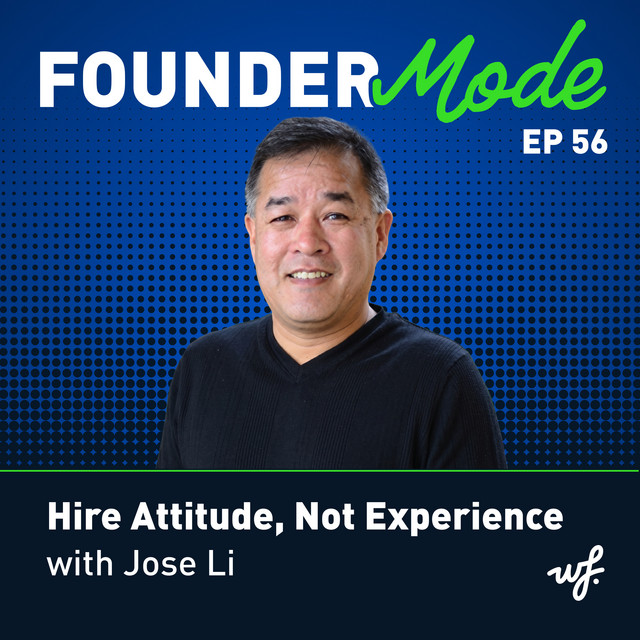
Hire Attitude, Not Experience with Jose Li
Welcome back to Founder Mode!
In this episode, we sat down with Jose Li, founder of 71 Pounds. He built a business around something most companies completely ignore: shipping refunds.
At first, it sounds simple. If FedEx or UPS delivers a package late, you get your money back.
Except almost nobody actually claims it.
Jose spent years inside FedEx before realizing there was a huge opportunity hiding in plain sight. Companies were leaving billions of dollars unclaimed because the process was frustrating, confusing, and buried in fine print.
So he built software to automate it.
What stood out to me most was not just the idea. It was the persistence. Jose has been building this company for more than a decade, through hiring mistakes, failed experiments, COVID nearly wiping out the business, and constant reinvention.
Let’s get into it.
1. Most Great Businesses Start With a Problem People Tolerate
Jose saw something broken that everyone had accepted.
FedEx and UPS both guarantee delivery times. If they miss the delivery window, customers are entitled to a full refund.
Almost nobody files the claim.
As Jose explained:
“Two billion dollars with a B are left unclaimed every year.”
That number is wild.
The process is intentionally painful. You need invoice numbers and tracking details, and you only have a short window to file claims. Most people just give up.
That is where opportunity lives.
I’ve seen this pattern over and over in startups. The best businesses are often built on annoying problems everyone else ignores.
2. Simplicity Wins
One thing I’ve always respected about Jose is how focused the business stayed.
At the beginning, 71 Pounds really did one thing well:
Recover shipping refunds automatically.
That clarity mattered.
Instead of trying to become an all-in-one logistics platform, they solved a very specific pain point and solved it extremely well.
As Jose explained:
“There are only two things that we do at our company. One, we help companies save money on shipping. Two, we give them data.”
That kind of focus is rare.
A lot of founders add complexity too early. More features. More products. More dashboards.
But customers usually just want one painful thing fixed.
3. COVID Forced the Company to Reinvent Itself
The most interesting part of the conversation was hearing how close the business came to disaster during COVID.
Their core business depended on shipping refunds.
Then, FedEx and UPS temporarily suspended refund guarantees during the pandemic.
Revenue dropped by roughly 90%.
That kills most companies.
Instead of shutting down, Jose and the team looked at the data they already had and built a second product: contract negotiation services.
Now they help businesses negotiate better shipping contracts using benchmark data from thousands of shipments.
Today, that second product generates more than half the company’s revenue.
That’s a huge founder lesson.
Sometimes survival comes from using the assets you already have in a different way.
4. Distribution Still Matters More Than People Think
One thing I appreciated was how honest Jose was about customer acquisition.
No magic growth hack.
No viral loop.
Just consistent execution.
Cold calls. Trade shows. SDRs. Follow-up systems. Refining messaging.
And surprisingly, trade shows are still one of their best channels.
Jose said:
“We’re very in your face, and we ask you, ‘Hey Jason, do you ship with FedEx or UPS?’”
Simple.
Direct.
Works.
I think founders underestimate how much repetition and consistency matter. Most businesses are built through boring execution done repeatedly.
5. Founders Have to Keep Evolving
The final thing that stood out was how Jose talked about his own role changing over time.
He used to code.
Now the engineering team does not let him code anymore.
He used to do sales.
Now the sales team handles that.
That evolution matters.
A founder’s job changes as the company grows.
At first, you do everything yourself.
Later, your job becomes:
- Setting direction
- Building systems
- Hiring the right people
- Finding the next opportunity
Jose summed it up perfectly when he talked about product development and guiding the roadmap based on customer feedback.
That’s founder mode.
5 Key Takeaways
- The best startup ideas are often frustrating problems people have accepted.
- Simplicity beats complexity early on.
- A second product can save the company when the first one gets disrupted.
- Cold calls and trade shows still work in 2026.
- Great founders evolve from operators into system builders.
Final Thoughts
This episode reminded me that persistence still matters more than almost anything else.
A lot of founders quit too early.
Jose spent 14 years building this company. Through failed experiments, changing markets, hiring mistakes, and COVID nearly shutting things down.
And now they’ve helped more than 5,000 customers recover over $80 million.
That doesn’t happen because someone had one brilliant idea.
It happens because they kept going.
One thing I said during the episode that I still believe:
“The best businesses often come from problems people tolerate.”
Most people see friction and move on.
Founders see friction and start building.
See you next time.
🎧 Listen to Episode 56 here:

This podcast builds on the Founder Mode newsletter.
Let’s build.
-kevin
2810 N Church St #87205, Wilmington, DE 19802
Unsubscribe · Preferences